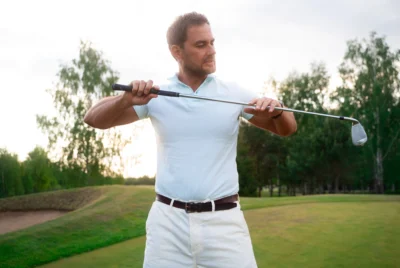


How to Use No-Ball Practice to Improve Golf Swing

Mastering technique through simplified, focused training
Improving your golf swing does not always require a driving range, advanced equipment, or even a ball. Some of the most effective training sessions involve no-ball practice, a method that allows golfers to isolate mechanics, build consistency, and develop better body awareness without the pressure of ball flight results.
This type of practice has become especially valuable for players with limited time, restricted space, or inconsistent access to golf facilities. With modern digital tools like Eye Swing, golfers can combine no-ball drills with swing analysis, real-time feedback, and data insights to achieve meaningful progress from home.
No-ball practice removes distractions and places full emphasis on movement quality—an essential ingredient for long-term improvement.
Why no-ball training is so effective
Eliminating outcome dependency
Golfers often react to the result of their shot—good or bad—without understanding the underlying mechanics that produced it. No-ball practice eliminates this tendency, allowing players to:
- Focus entirely on technique
- Feel movement more clearly
- Detect imbalances and compensations
- Understand sequencing without external noise
Without the distraction of ball flight, golfers can concentrate on repeating correct patterns, laying the foundation for a more reliable and efficient swing once a ball is reintroduced.
Improving motor learning and muscle memory
Repetition is essential in golf, but repetition without intention can reinforce poor habits. No-ball training enhances motor learning by encouraging slow, controlled movements that develop precision and awareness.
When paired with Eye Swing’s video analysis, golfers can verify whether each rehearsal matches the intended mechanics, accelerating the learning process.
Key elements to focus on during no-ball practice

Posture and setup consistency
A solid golf swing begins with proper setup—yet many golfers overlook this simple foundation. No-ball practice is ideal for refining:
- Spine tilt
- Arm alignment
- Knee flex
- Weight distribution
- Club position at address
Eye Swing allows players to record and compare setups across sessions, ensuring these foundational elements remain consistent.
Backswing structure and rotation
Because the backswing sets the stage for the downswing, golfers must reinforce proper rotation and positioning. No-ball practice helps players refine:
- Shoulder turn
- Hip rotation
- Arm depth
- Wrist hinge timing
- Pressure shift into the trail leg
Practicing these movements slowly builds reliable mechanics that transfer smoothly to full-speed swings.
Downswing sequencing and timing
No-ball practice is especially powerful for improving sequencing, one of the most challenging aspects of the swing. Golfers can rehearse:
- Lower-body initiation
- Torso rotation follow-through
- Arm and hand positioning
- Club delivery into impact
Eye Swing’s slow-motion feedback helps identify whether the sequence follows the correct kinetic chain.
Impact position visualization
Even without a ball, golfers can rehearse proper impact alignments, such as:
- Forward shaft lean
- Correct weight shift toward the lead side
- Square clubface position
- Balanced lower-body structure
Training this position repeatedly builds the awareness needed to produce more consistent contact on the course.
Follow-through and balance control
Finishing in a stable, balanced position demonstrates that the preceding movements were well-coordinated. No-ball drills help refine:
- Extension of arms and torso
- Rotation into the lead side
- Vertical and horizontal balance
- Tempo and rhythm through completion
These elements reinforce a complete, controlled swing cycle.
Effective no-ball drills for measurable progress
Mirror work for posture and rotation
Practicing in front of a mirror helps golfers visually confirm their positions. This drill enhances awareness of spine angle, hip depth, and shoulder rotation. Eye Swing complements this by providing video feedback for long-term tracking.
Slow-motion sequencing rehearsals
Performing the swing at 25–50 percent of full speed allows players to concentrate on accuracy rather than power. Eye Swing’s frame-by-frame review helps refine positions and transitions during these slow rehearsals.
Impact preset repetitions
Golfers set the club and body into a proper impact position, then return to address and repeat. This drill reinforces body alignments that produce solid contact and helps eliminate flipping or early extension.
Step-through drill for weight transfer
Stepping forward during the downswing encourages proper weight shift toward the lead side. Even without a ball, this movement builds dynamic balance and improves lower-body engagement.
Using Eye Swing to enhance no-ball practice
Turning simple rehearsals into data-driven improvement
No-ball practice becomes dramatically more effective when paired with technology. Eye Swing supports this type of training through:
- High-quality video capture
- Real-time swing analysis
- Visual markers for position checkpoints
- Long-term progress tracking
- Remote coaching feedback
Because no-ball swings are easier to record repeatedly, golfers can generate more data and refine their mechanics more efficiently. Coaches can observe patterns, identify inconsistencies, and recommend precise corrections based on reliable visual information.
Integrating no-ball practice into a regular routine

Short, frequent sessions produce the best results
One of the key advantages of no-ball practice is the ability to perform it anywhere—indoors, outdoors, or in limited spaces. Incorporating 10–15 minutes of intentional, no-ball rehearsals several times a week can create meaningful improvements.
Combining these sessions with periodic feedback through Eye Swing ensures that the movements being reinforced remain technically correct and aligned with long-term goals.
You can Improve Golf swing by mastering movement
No-ball practice offers golfers a simple yet powerful way to refine technique, build awareness, and develop more consistent mechanics—even without access to a driving range. By removing external distractions, players can focus on movement quality and create lasting improvements.
With the support of Eye Swing’s video analysis, data insights, and expert feedback, no-ball training becomes an essential tool for modern golf development. The result is a more reliable, efficient, and confident swing that holds up on the course.